
More and more companies we work with are asking the same question: how do we get AI to recommend us in chats with potential customers?
For most of the internet era, digital visibility came down to one primary job: rank on Google. That job still matters, of course, but it is no longer the whole job. Buyers can now open ChatGPT, Gemini, or Claude, describe a problem in plain language, and get a synthesized answer that may surface only a handful of companies.
The shift changes what it means to be visible.
Traditional SEO helps you win the results page. GEO helps you position your brand as the answer itself.
Our client was early to recognize the opportunity. Its combined Search Engine Optimization (SEO) and Generative Engine Optimization (GEO) program with Deviate Labs offers a useful look at what answer-engine visibility actually requires: a strong traditional search foundation, content organized around the questions buyers ask, technical precision, and a measurement system that shows whether any of it is working.
And in our client's case, the measurement got pretty lopsided.
Across the ChatGPT and Gemini prompts we tracked from the beginning, our client's presence grew from 19% in December 2025 to 90% by July 2026. Furthermore, in a separate competitive snapshot across three answer engines, our client generated more than twice as many appearances as its nearest major competitor.
The interesting part is how we got there. We came into the work with deep SEO experience, but GEO was new enough that there was no established playbook, no standard measurement system, and very little consensus around what actually moved visibility inside answer engines. In some ways, we had to build the methodology while we were executing it.
In this case study, we'll walk through how we combined a strong SEO foundation with a new GEO framework, built a way to measure the results, and ultimately turned our client into the clear visibility leader among its two biggest competitors.
The Client
Our client, founded in 2014, is a venture-backed software company operating in a complex, highly regulated market. Its platform helps businesses navigate the security, compliance, and accreditation requirements that stand between their products and end users.
Our client sells into a market where buyers are highly technical, terminology matters, and credibility can disappear with a single inaccurate sentence. A fuzzy explanation of a core compliance framework can be a reason for the reader to stop trusting the source altogether.
Our client had also invested in SEO well before GEO became a serious marketing priority. That SEO foundation turned out to be one of the most important parts of the story.
As we reviewed our client's Search Console data, we saw increasingly conversational, question-shaped searches. They looked less like traditional keyword queries and more like a chat log with an AI assistant. In other words, AI-style research behavior was already reaching our client's audience.
The question was no longer whether buyers would use answer engines. It was whether our client would show up when they did.
Why Traditional SEO Metrics Cannot Measure AI Visibility
Traditional SEO has decades of tooling, established metrics, and accumulated best practices behind it. GEO doesn’t.
For our client, the newer discipline created three practical problems.
First, visibility inside answer engines needed its own measurement system. Google Search Console could tell us whether a page ranked or earned a click, but it could not answer a much newer question: when someone asks ChatGPT or Gemini a buying question, does our client appear?
Second, the content had to work for two demanding audiences at the same time. Technical experts need precision. Answer engines also need information presented clearly enough to identify, interpret, and reuse.
Third, the search landscape was much bigger than a list of high-volume keywords. Buyers ask questions such as "What is the fastest way to achieve the required authorization?", "Should a company build its own compliance environment?", or "Which platforms can deploy commercial software into regulated environments?" The underlying topics overlap with traditional keyword research, but the format is much closer to a real conversation.
Optimizing only for Google keywords would have worked in 2020, but in 2026, we needed to address the total search landscape.
Does SEO Still Matter for AI Search Visibility?
Although slightly counterintuitive, the AI visibility win did not start with AI.
Our client had already committed meaningful resources to organic search visibility in the months leading up to the focus on GEO. Working together, we conducted several technical SEO audits, addressed a toxic backlink profile, and built a strategic content roadmap around the topics our client needed to own.
We also identified and updated existing pages with meaningful search demand and opportunities to improve their positions (ie, pages in “striking distance”).
At the same time, our client kept publishing. By July, the roadmap included more than 20 published articles, and every piece of content in the program went through our client's subject-matter approval process before publication.
The organic footprint was large, and it was moving in the right direction, fast.
In January 2025, our client generated roughly 124,000 monthly search impressions. A year later, that number had climbed 69% to more than 210,000, while its average Google position improved from 21.6 to 10.1. By July 2026, our client was approaching 280,000 monthly impressions with an average position of 7.7.

The individual content wins were getting bigger too. One explainer grew from roughly 34,000 impressions in January 2026 to more than 58,000 by July, about 70% growth in six months. A second explainer generated another 30,000-plus impressions that month alone. The individual content wins were getting bigger too. One explainer grew from roughly 34,000 impressions in January 2026 to more than 58,000 by July, about 70% growth in six months. A second explainer generated another 30,000-plus impressions that month alone.
Those improvements weren’t benefitting obscure long-tail pages picking up a few hundred searches. Instead, our client was building meaningful visibility around the exact subjects it wanted to own.
The rankings told a similar story. By March, our client held exceptionally strong positions on complex technical topics, at times ranking above official reference sources and major technology providers.
More importantly, organic search was producing qualified demand. Organic traffic converted into sales-qualified leads at more than twice the rate of paid search and more than three times the rate of paid social. The pattern held further down the funnel too: organic converted into sales-qualified opportunities at roughly 50% higher than paid search and more than 2.5X the rate of paid social.
In other words, search was generating visibility, and it was attracting the kind of buyers our client actually wanted.
That combination of scale, ranking authority, and lead quality created a strong base for the next phase.
How to Turn Keyword Research Into Concept Themes
Traditional keyword research organizes demand around phrases. GEO also needs to organize demand around ideas.
We grouped our client's search landscape into six Concept Themes:
- Authorization
- Compliance
- Strategy, Cost & ROI
- Technical Compliance
- Contracting & SaaS Readiness
- Cybersecurity Strategy
Those categories also became part of our client's ongoing organic-search reporting.
Our client supplied the core prompts it cared about. Deviate organized those questions into the broader GEO framework and used them to define what we would measure.
The distinction matters. The goal was to map the territory our client needed to show up for when a buyer stopped typing keywords and started asking complete questions (rather than adding ‘AI questions’ to an SEO spreadsheet haphazardly).
The Concept Theme map became the bridge between content strategy and AI visibility.
How to Structure Content So AI Models Can Extract It
The content itself had to do more than target keywords.
Accuracy came first. Every piece of content in the program went through our client's SME approval process before publication. In a category built around security and compliance, technical accuracy is much more than an editing detail: it is the price of admission.
We also applied GEO-oriented structural changes to live content so important information was easier to understand and extract. Those edits included clearer organization, more direct treatment of important questions, and page structures that made the answer easier to find instead of burying it several paragraphs down.

The broader SEO audits had identified exactly this kind of opportunity. Our client already ranked well for several complex technical topics, but additional restructuring and more explicit formatting could improve how search engines and answer engines interpreted the material.
Freshness became another part of the work. Dates and metadata were updated on relevant high-impression pages so the external signals around the content better reflected the currency of the information. In a field where terminology and program structures can change quickly, stale content has a short shelf life.
None of these tactics required choosing between SEO and GEO.
The same qualities tend to help both: accurate information, clear hierarchy, direct answers, useful context, and current sourcing. The tactics are distinct, but the underlying philosophy overlaps quite a bit.
How to Measure Whether AI Answers Mention Your Brand
Then came the measurement problem.
We built a custom tracking system around our client's prompt set. For each tracked question, we checked whether our client appeared in the answer and reported the results over time.
The program initially focused on ChatGPT and Gemini. Claude was later added to the reporting suite, giving our client visibility across three major answer engines.
The system can also track competitors, which was helpful to contextualize our data. (A brand appearing 60% of the time sounds good until you discover its biggest competitor appears 95% of the time.)
For purposes of the analysis, an appearance means our client was surfaced through a citation, link, or brand mention. (We use the broader term deliberately because answer engines don’t all present sources in exactly the same way.)
The tracker gave us a prompt-by-prompt scoreboard of our client’s visibility, as well as whether it was gaining or losing ground against the companies buyers were most likely to consider alongside it.
The Results: From 19% to 90%
The first result was the trajectory.
When tracking began in December 2025, our client appeared in 19% of the monitored ChatGPT and Gemini searches. By July 2026, the figure had climbed to 90%.
In a little more than half a year, our client went from appearing in fewer than one in five monitored answers to appearing in nine out of ten.
Next, we looked at the competitive picture.
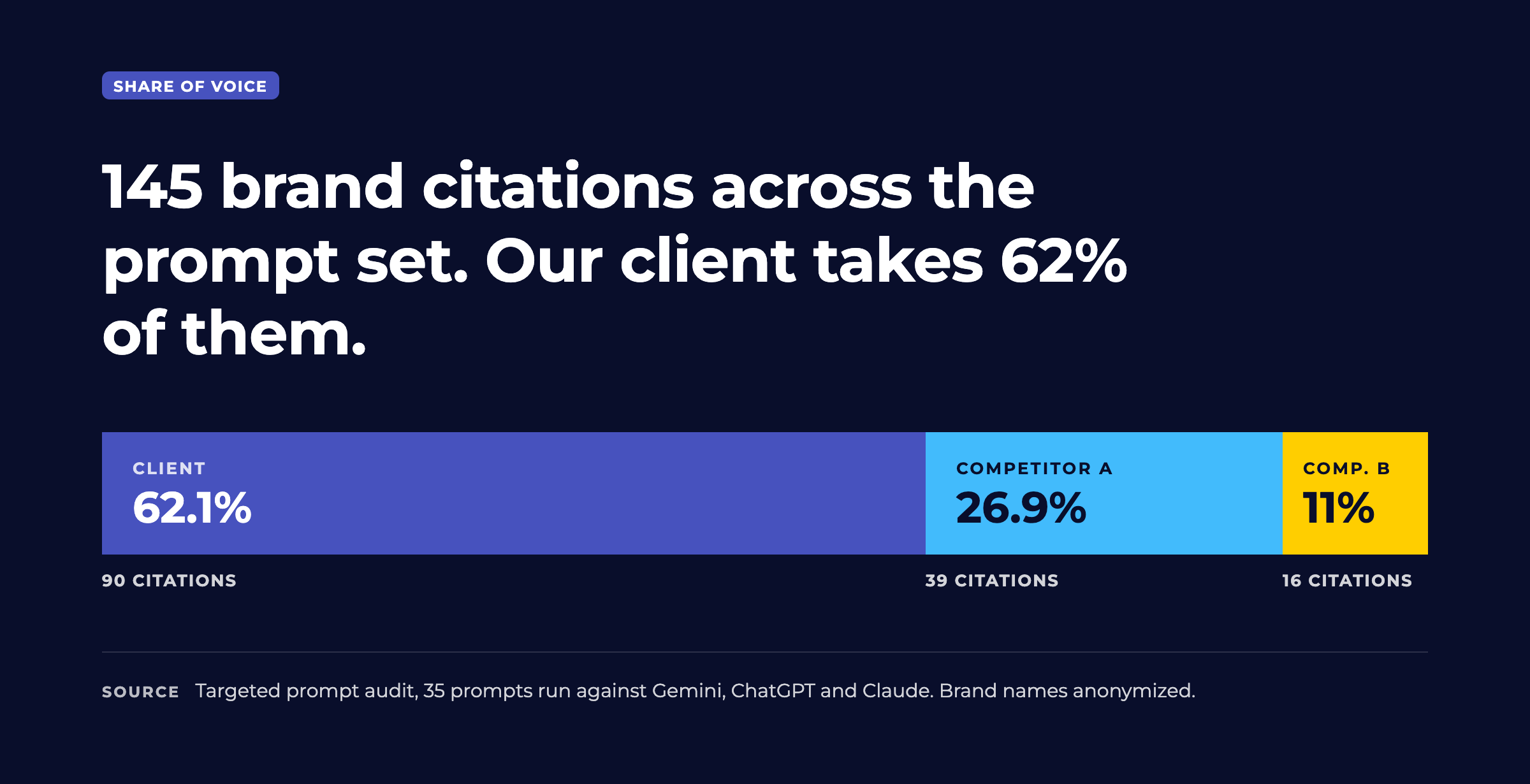
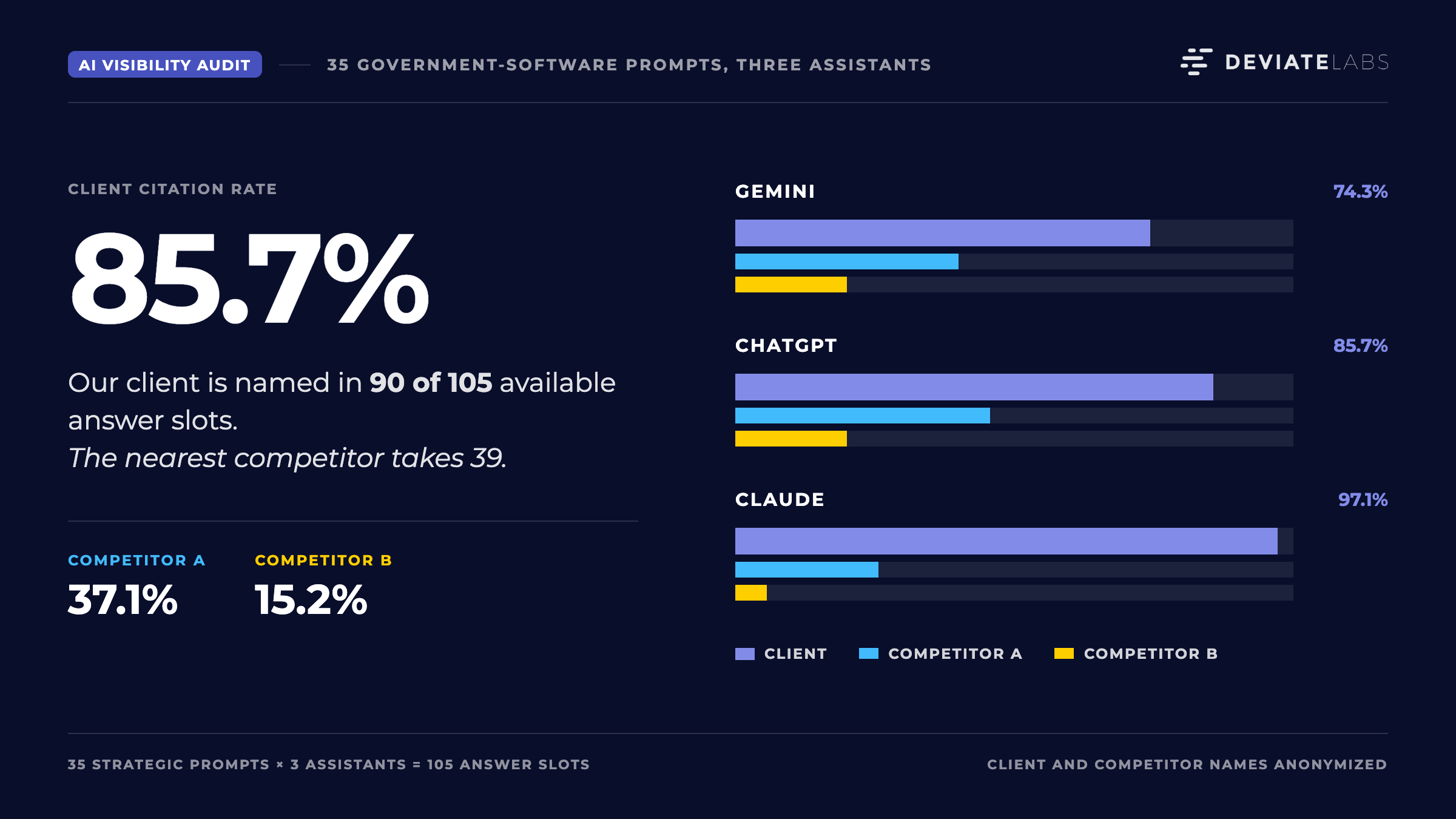
This separate snapshot compared our client against its two biggest competitors across 35 prompts and three answer engines: Gemini, ChatGPT, and Claude. That created 105 possible appearances for each company.
Our client appeared 90 times.
Its two biggest competitors appeared 39 and 16 times.
So yes, our client won. But "won" understates the gap.
Our client generated more than 2.3X the appearances of its nearest competitor and more than 5.6X the appearances of the other.
The lead also held on every individual engine:
- Gemini: Client 26, Competitor A 14, Competitor B 7
- ChatGPT: Client 30, Competitor A 16, Competitor B 7
- Claude: Client 34, Competitor A 9, Competitor B 2
Claude was especially stark. Our client appeared in 34 of 35 prompts.
SEO Fed the GEO Engine
The most important takeaway is that GEO does not replace SEO. In fact, the opposite is closer to the truth: the strategy worked because the two disciplines reinforced each other.
Traditional SEO helped build the searchable body of knowledge: technical improvements, established rankings, authoritative pages, more than 20 published articles, and growing organic demand.
GEO expanded the target from rankings into answer-engine visibility. Concept Themes organized the questions. SME review protected accuracy. Structural improvements made information easier to interpret. Freshness work kept important pages current. And the tracker showed whether our client was actually appearing.
By July, our client was generating nearly 280,000 organic impressions per month while appearing in 90% of the ChatGPT and Gemini searches we tracked.
Different metrics, same underlying authority.
Traditional SEO helped our client win the results page. GEO helped position the brand as the answer itself.
What Happens Next
Answer-engine visibility is not something a company wins once. New buyer questions emerge. Models change. Competitors publish. Industry terminology evolves. Content that is accurate today may need revision six months from now.
That reality makes GEO an ongoing operating discipline rather than a one-time optimization project.
Every useful new article creates another potential source an answer engine can surface. Every refresh keeps existing material current. Every new prompt added to the tracker expands the team's view of where the brand is visible and where a competitor still owns the conversation.
There is no guarantee that one appearance automatically produces the next. But there is a clear strategic advantage in building a larger, more accurate, more discoverable body of material around the questions a market repeatedly asks.
Our client started that work early.
The result is measurable: stronger organic visibility, high-quality demand from search, a 19% to 90% improvement across the answer engines tracked from the beginning, and a more than 2X visibility lead over its nearest major competitor in the broader three-engine analysis.
For marketers, the lesson reaches well beyond one highly regulated software category.
Your buyers still search.
Increasingly, they also ask.
You need to be ready for both.
The TL;DR
- The Client: A venture-backed software company, founded in 2014, whose platform helps businesses navigate complex security, compliance, and accreditation requirements in as little as 90 days.
- The Challenge: Search behavior was expanding into AI answer engines, creating a visibility problem traditional rankings alone could not measure.
- Build on our client's established SEO foundation, organize demand into six Concept Themes, publish SME-approved content, make live content easier for humans and models to interpret, and build a custom AI visibility tracker across ChatGPT, Gemini, and Claude.
- The Results:
- Our client’s AI visibility rose from 19% of tracked ChatGPT and Gemini searches in December 2025 to 90% by July 2026.
- In a separate benchmark across 35 prompts and three answer engines, our client ranked first by a wide margin, appearing 90 times out of 105 possible responses compared with 39 for its nearest competitor and 16 for the other.
- The Lesson: SEO and GEO are complementary strategies. Strong search authority gives answer engines better material to surface, while GEO expands the definition of visibility from ranking in results to becoming part of the answer.